
Sundew Care (Drosera)

Drosera: Cape sundew (D. capensis), giant sundew, rosette sundews and more
At a glance
| ☀️ Light | Bright: a sunny windowsill or grow light. |
|---|---|
| 💧 Water | Always moist. Sit the pot in a tray of rain or distilled water. |
| 🪴 Soil | Nutrient-free: our Carnivorous Blend. |
| 🌡️ Temp | 10–30°C. Cape sundew needs no winter rest. |
| 💨 Humidity | Average to high. |
| 🐾 Pets | Pet safe Not known to be toxic to cats and dogs. |
| 🌱 Care level | Moderate Carnivorous |
| 📏 Grows to | 5–30 cm, depending on species. |
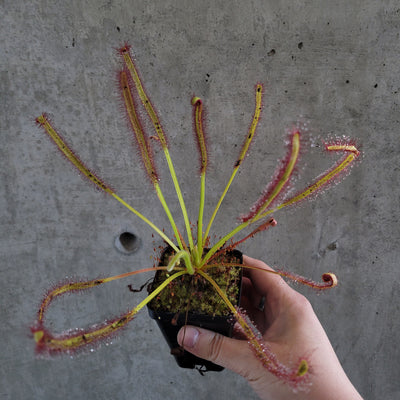
Sundews catch insects with leaves covered in glistening, sticky tentacles that slowly curl around their prey. They're mesmerizing to watch, great at catching fungus gnats, and the Cape sundew is one of the easiest carnivorous plants to grow on a windowsill.
Light + placement
Sundews need lots of light to make their sticky "dew." A south or west window with a few hours of direct sun is ideal, or a grow light 12–14 hours a day. In low light they turn green and floppy and stop producing dew.
Watering
Carnivorous plants grow in bogs, so the soil should never dry out. The easiest way is the tray method: stand the pot in a saucer with 1–2 cm of water and top it up as it drops. Use only rain, distilled or reverse-osmosis water; minerals from tap water build up and burn the roots over time.

Soil + repotting
Use a nutrient-free mix, like our Carnivorous Blend (peat and perlite), in a plastic or glazed pot. Never use regular potting soil or fertilizer-added mixes. Repot every 1–2 years in spring.
Feeding + upkeep
Don't fertilize the soil. Your sundew catches its own insects; if it's indoors with few bugs, you can drop a tiny bit of fish food or a dried bloodworm onto a sticky leaf once or twice a month. Trim old black leaves and flower stalks as they fade.
Propagation
Cape sundews self-seed readily: you'll often find babies popping up in the pot. You can also root a leaf cutting on wet carnivorous mix. See Propagation 101.
Common problems
| What you see | Likely cause | What to do |
|---|---|---|
| No sticky dew on the leaves | Not enough light or humidity | Move to a sunnier window or add a grow light. |
| Crispy, black leaves | Soil dried out | Keep it in a water tray at all times. |
| Slow decline, browning roots | Tap water or fertilizer | Repot in fresh Carnivorous Blend; switch to rain or distilled water. |
| Green, floppy leaves | Low light | More light; red colour returns in sun. |
| Old leaves turning black | Normal ageing | Trim them off. |
Varieties we carry
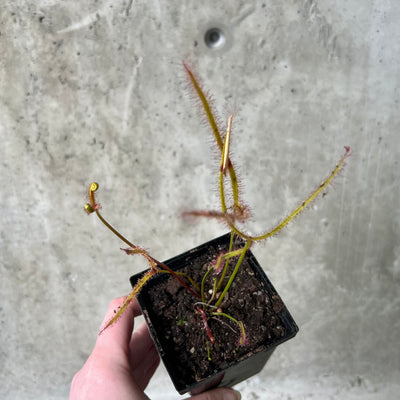
Same basic care for all of our sundews. Cape sundews are the easiest. Only what's in stock online right now is shown.
Frequently asked questions
Do I need to feed my sundew?
Not if it catches insects. Indoors, a tiny bit of fish food once or twice a month helps.
Can I use tap water?
It's best not to. Use rain, distilled or reverse-osmosis water to avoid mineral build-up.
Will it catch fungus gnats?
Yes. Sundews are excellent at it. See How to Get Rid of Fungus Gnats.
Is a sundew safe for pets?
It's not known to be toxic, but the sticky leaves are delicate, so keep it out of reach.
Sundew care kit
- Carnivorous Blend: Our nutrient-free Soil Bar mix for fly traps, sundews and pitcher plants.
- Sticky Traps: Catches fungus gnats before they multiply.
- Squeezy Watering Bottle: Precise watering for small pots and terrariums.
Bring your plant (or a photo) to 515 Chatham St #103 and we'll take a look. Open 11–5, 7 days a week, with street parking nearby. Get directions →
More plant care guides
Venus Fly Trap · Alocasia · Tradescantia · Goldfish + Lipstick Plants · Air Plants · Pink Princess · Monstera Adansonii · Anthurium · All plant care →