
Lithops Care (Living Stones)

Lithops (living stones)
At a glance
| ☀️ Light | As much as possible: your sunniest window. |
|---|---|
| 💧 Water | Only in spring and fall, when the soil is bone dry. Never in summer or while splitting. |
| 🪴 Soil | Very gritty: our Arid Potting Mix with extra grit. |
| 🌡️ Temp | 10–30°C. |
| 💨 Humidity | Dry air is perfect. |
| 🐾 Pets | Pet safe Non-toxic to cats and dogs. |
| 🌱 Care level | Moderate Pet safe Needs sun |
| 📏 Grows to | 2–4 cm tall. |
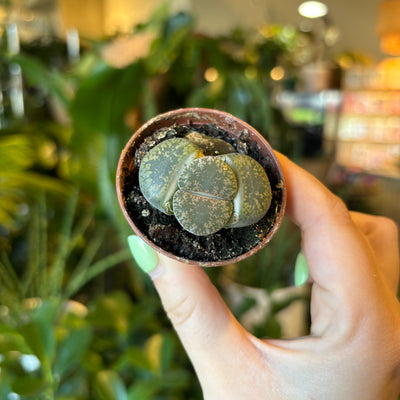
Lithops look like little pebbles, which is exactly how they avoid being eaten in the South African desert. They're tiny, fascinating and easy once you learn the one rule: most lithops die from too much water, not too little.
Light + placement
Lithops need lots of direct sun: a south or west window, as close to the glass as possible. In low light they stretch tall and lose their pebble shape. A grow light helps in winter.
Watering
Lithops have a yearly rhythm. Water deeply only when the soil is completely dry and the plant is actively growing: mainly in fall (Sept–Nov) and lightly in late spring. Don't water in summer (they're dormant) or in winter and early spring while the new leaf pair is growing inside the old one.
- Slightly wrinkled in the growing season means it's ready for water.
- Swollen, split or mushy means too much water.
- In doubt? Don't water.

Soil + repotting
A very gritty, fast-draining mix: our Arid Potting Mix with extra pumice or grit, in a small pot with a drainage hole. Lithops rarely need repotting.
Feeding + upkeep
No fertilizer needed; at most once in fall at quarter strength. Leave the old, shrivelling leaves alone; the new pair absorbs their water and nutrients.
The yearly leaf change
Each winter a new pair of leaves grows inside the old pair, which slowly wrinkles and dries into a papery skin. This looks alarming, but it's normal. Don't water during this time, or the plant may rot or grow a double layer.
Flowers
In fall, healthy lithops push a white or yellow daisy-like flower out of the centre slit, usually in the afternoon sun.
Common problems
| What you see | Likely cause | What to do |
|---|---|---|
| Mushy, split or bursting | Too much water | Stop watering; let it dry completely. |
| Tall, stretched, pale | Not enough sun | Move to the sunniest window or add a grow light. |
| Old leaves shrivelling in winter | Normal leaf change | Leave them; don't water. |
| Wrinkled in fall | Thirsty (growing season) | Water deeply once, then let it dry. |
| Two pairs stacked on top of each other | Watered during the leaf change | Hold off watering until the old pair dries. |
Varieties we carry
We carry assorted lithops in many colours and patterns. All need the same care. Only what's in stock online right now is shown.
Frequently asked questions
How often should I water lithops?
Only a few times a year: mainly in fall, and lightly in late spring, when the soil is bone dry.
Why is my lithops shrivelling?
If it's winter or early spring, it's probably the normal leaf change. Don't water.
Are lithops safe for pets?
Yes. They're non-toxic to cats and dogs.
Can I keep lithops with other succulents?
Only if you can water them separately. Most succulents need more water.
Lithops care kit
- Arid Potting Mix: Our fast-draining Soil Bar mix for plants that like to dry out.
- Squeezy Watering Bottle: Precise watering for small pots and terrariums.
Bring your plant (or a photo) to 515 Chatham St #103 and we'll take a look. Open 11–5, 7 days a week, with street parking nearby. Get directions →
More plant care guides
Indoor Palms · Peace Lily · Fittonia · Pilea · Pitcher Plant · String of Pearls · Cactus · Olive Tree · All plant care →